Congress leaders have a spring in their steps these days.
With the Narendra Modi government under fire for a wide range of issues, the mood in the grand old party is upbeat.
After meeting its representatives, one comes away with the impression that they are within touching distance of power.
Chief Election Commissioner “Gyanesh Kumar has given a tangible form to the whole vote chori scam”, a Congress MP said to me this week, referring to his party’s year-old campaign about alleged election rigging.
“People have found one visible guy to understand that everything is not right.
We are gathering them around a simple demand” – for Kumar’s resignation.
Another politician from the party, this one from eastern India, claimed that the Modi government’s days are numbered.
He harked back to the years leading up to defeat of the Congress-led United Progressive Alliance in 2014, when it too was beleaguered by street protests.
The shift in approach is striking, given that Congress leaders until just a few months ago were offering esoteric explanations for why this was neither the right time nor the right way to protest.
In fact, at a meeting of the Opposition INDIA bloc in June, Rahul Gandhi himself had questioned the Cockroach Janta Party political campaign’s demand for the resignation of Dharmendra Pradhan, the Union education minister at the time.
A representative from another political outfit who was there told me that Gandhi had called Pradhan a “low-hanging fruit”.
So what triggered the turnaround? I posed this question to a Congress official while we were sitting in his home in Delhi one evening earlier this week.
“You see that boy?” he asked me in a hushed voice, his thumb pointing to the twentysomething sitting in the room behind him.
“He handles my social media.
All through July, I would sternly tell him to go straight to his home after finishing work every evening.
I found out later that he was going to Jantar Mantar and staying there till 3 am or 4 am almost every day.” The Gen Z protesters – born between the late 1990s and 2010 – had done to Prime Minister Narendra Modi in merely a matter of days what Congress bigwigs had not been able to do in decades, the man said.
“The kind of things they said there,” he elaborated, pausing to gasp in surprise.
“We politicians don’t say anything close to that because we live in fear of Narendra Modi and Amit Shah.
Frankly, I don’t have it in me to speak out against them like that.” In his view, as well as that of other Congress insiders to whom I have spoken to recently, the Jantar Mantar protests had jolted the party out of its stop-start rhythm as an election-contesting machine.
It was forced to shift gears and hit the ground to keep up with the protesting students and youth.
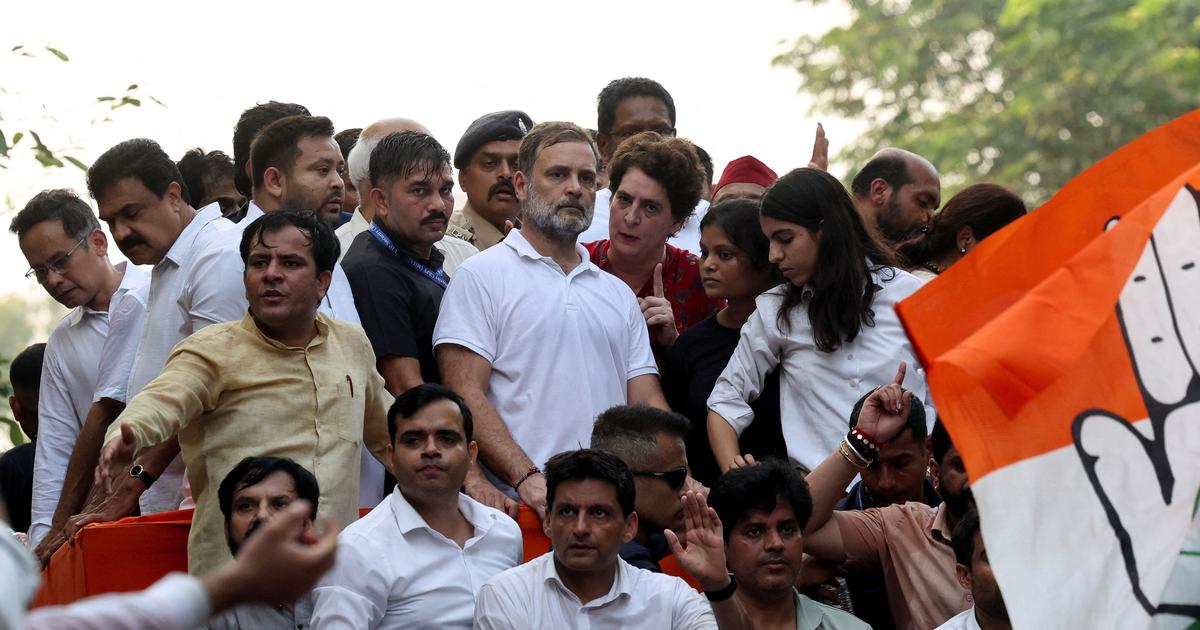
To be sure, the signs of the change of tack had started to show in July itself, when Gandhi led other Congress MPs in a surprise march to the prime minister’s residence to stage a sit-in.
Since then, Gandhi and the party have protested in Delhi on several occasions, their attacks only growing sharper....