On a Saturday afternoon in Dhaka, a group of young people decided that Rabindranath Tagore needed to be erased.
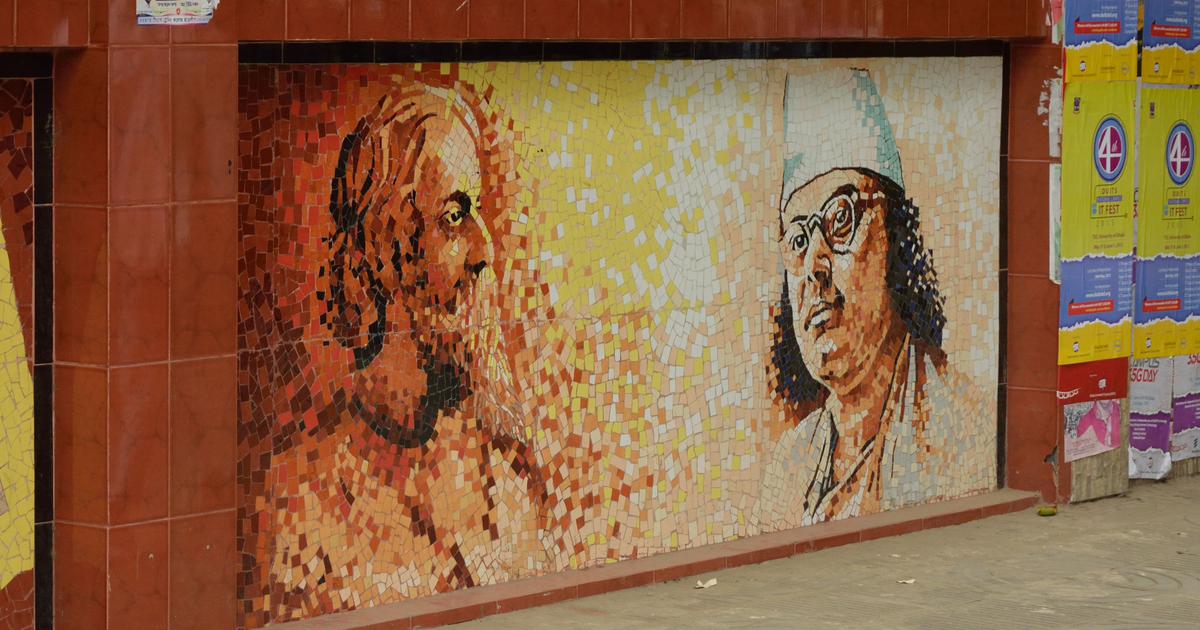
They arrived outside the Bangladesh Shilpakala Academy in Segunbagicha, where a newly painted mural displayed the faces of Bengali cultural figures.
One of them, a young woman, began smearing black ink across Tagore’s portrait.
The police intervened and four people were detained, including ANM Ayas, a 29-year-old activist associated with the Rashtra Sanglap Forum who had recently attracted attention on social media through a series of provocative public antics.
Their act of cultural vandalism soon became a criminal case.
A Dhaka court placed all four on remand on October 11, with allegations involving criminal conspiracy, inciting enmity between groups and religious hatred.
One woman reportedly explained the group’s motive as opposition to Indian aggression.
Tagore, in this formulation, was not a poet born in Bengal decades before Partition.
He was an Indian symbol to be removed from a Bangladeshi wall.
The argument was historically impoverished.
The reaction to it was more revealing.
Later, the cultural organisation Udichi assembled musicians, singers and activists on the pavement beneath the murals.
A man in a blue checked shirt played a harmonium resting on a plastic stool.
A woman in a green sari sang into a microphone.
Others joined her in Tagore’s Ekla Cholo Re, the song urging a person to walk alone when nobody answers the call.
There was no elaborate stage and microphone cables ran across the pavement.
Elderly participants sat beside younger performers.
Portraits of Tagore leaned against the wall, accompanied by quotations about humanity and religious tolerance.
It was a modest response.
Someone had attacked a poet’s image and his admirers answered with his music.
Then came the internet.
A video of the performance uploaded by a television channel received around 40,000 Facebook reactions.
Approximately 38,000 were laughter reactions.
That is 95%.
Well, the figures should not be mistaken for an opinion poll.
Facebook reactions are self-selecting and vulnerable to coordinated activity.
It is also poor at explaining motivation.
Some viewers may have been mocking the performers, others the politics surrounding them, and some simply joining an online joke.
But the scale of the reported derision is difficult to ignore.
Here was one of Bengal’s greatest literary figures (if not the greatest one), defended through one of his best-known songs, becoming the object of mass digital ridicule.
This irony captured a problem larger than the vandalism itself.
In Bangladesh, Rabindranath has become something resembling a religion.
It has ceremonies, custodians, sacred texts, approved interpretations and accusations of heresy.
The problem is that this religion is political rather than spiritual.
And its most enthusiastic defenders may have helped create the backlash they now find incomprehensible.
The making of a secular deity Rabindranath Tagore was not born to serve the cultural requirements of a modern nation-state.
He died in 1941, six years before India and Pakistan emerged from British rule and three decades before Bangladesh became independent.
His intellectual life was too restless to fit comfortably inside any national ideology.
He wrote about love, nature, mortality, education, rural poverty, spiritual freedom and the limits of nationalism.
He criticised imperialism while questioning forms of nationalism that subordinated individual conscience to collective identity.
He was also capable of contradiction and misjudgment.
That last characteristic tends to disappear whenever a writer becomes a national monument.
Bangladesh’s relationship with Tagore predates Sheikh Hasina and the Awami League’s autocratic rule.
His songs were part of Bengali cultural resistance during the Pakistan period.
The Pakistani state's suspicion of Tagore helped make his music a symbol of linguistic and cultural freedom.
During the Liberation War, his writing offered a language of attachment to Bengal that transcended the religious nationalism on which Pakistan had been founded.
Amar Shonar Bangla became Bangladesh’s national anthem because its expression of affection for the land resonated with the country’s struggle for independence.
There was nothing artificial about that attachment.
The problem emerged when a literary inheritance became a political test.
Under Sheikh Hasina, who ruled from 2009 until the mass uprising of August 2024, the Awami League increasingly presented itself as the principal guardian of Bangladesh’s Liberation War identity and secular cultural tradition.
Tagore occupied an important place in that narrative.
His songs accompanied state ceremonies.
His image appeared in public commemorations.
Cultural institutions associated with Bengali secular nationalism received prominence in the official imagination.
None of those practices was objectionable in itself.
Governments everywhere commemorate writers, musicians and historical figures.
The difficulty begins when admiration becomes an expectation of political conformity.
Among critics of the Awami League’s cultural politics, Tagore became associated with an establishment that claimed special authority to determine what counted as enlightened and authentically Bengali.
To challenge that establishment was sometimes to risk being portrayed as culturally backward or hostile to the spirit of the Liberation War.
The difference between defending a poet and defending a political order became increasingly difficult to maintain.
This did not mean that everyone who admired Tagore supported Hasina.
Many of her opponents were devoted readers and performers of his work.
Nor was the Awami League the sole institution responsible for his elevated cultural status.
But the party’s long incumbency gave it unusual power to associate its political identity with an established national inheritance.
And that association carried a cost.
When Hasina’s government collapsed in 2024 amid mass protests and a deadly crackdown, the rejection extended beyond the government itself.
Symbols, institutions, cult and cultural practices perceived as belonging to its political universe came under renewed scrutiny.
Tagore was among those caught in the argument.
A poet who had belonged to Bengal for generations was increasingly treated, in some political circles, as though he belonged to a recently defeated government.
It was a “remarkable” reduction.
The Awami League had not invented Rabindranath.
Yet its opponents could now behave as though rejecting the party required rejecting the poet.
This happened because the poet had been turned into a political credential under Awami watch.
Once that happened, refusing the credential became a political act.
A generation that refuses the ceremony There is another problem, one that cannot be explained entirely through politics.
Rabindra Sangeet is not naturally suited to every generation's listening habits.
Much of it requires patience.
The compositions often unfold gradually, placing demands on melody, language, circumstances and emotional attention.
The experience can be intimate and rewarding.
It is not necessarily designed to compete with a 15-second video, a hip-hop track or the immediate pleasures of contemporary pop.
That does not make younger listeners culturally deficient.
Every generation develops its own musical vocabulary.
Bangladesh’s young people inhabit a world of rap, electronic music, independent bands, streaming platforms and global influences.
Their relationship with Bengali identity need not resemble their grandparents’ relationship with it.
A young Bangladeshi can prefer hip-hop to a harmonium and remain entirely Bengali.
Indeed, the assumption that an educated, culturally aware person ought to appreciate Rabindra Sangeet is part of the problem.
Music becomes less inviting when enjoying it is treated as evidence of moral superiority.
Still, the generational argument has limits.
Tagore’s compositions are not uniformly slow, and young musicians have repeatedly adapted his work.
His songs contain anger, urgency, playfulness and political defiance alongside contemplation.
The issue is not simply that the music has aged.
It is that the institutions presenting it sometimes seem to have aged more quickly than the music itself.
A cultural tradition survives when people find new reasons to inhabit it.
It becomes vulnerable when institutions insist that inherited reasons should be sufficient.
For sections of Bangladesh’s Gen Z and millennial population, the rejection of Tagore may therefore be about the political and social world associated with their performance.
The television footage from Segunbagicha makes the distinction worth considering.
The performers appeared sincere and their protest against vandalism was legitimate.
The song was appropriate to the occasion.
But the visual vocabulary was ludicrously stereotype and familiar…harmonium, portraits, solemn recitation, established cultural activists, familiar slogans.
For an audience already suspicious of Dhaka’s secular cultural establishment, the event could be interpreted not as just another appearance by an old political-cultural order.
That became synonymous with Awami fascism.
That interpretation may be unfair to the individual performers.
Udichi has a history extending well beyond Hasina’s government, and cultural activists have faced repression and violence themselves.
Yet public perception does not always respect institutional history.
A political identity can attach itself to an artistic practice so firmly that the audience stops distinguishing between the two.
The laughter reactions may partly reflect that association.
They may also reflect the internet's preference for mockery over argument.
But they cannot establish that 95% of Bangladeshis dislike Tagore, or even that 95% of those viewers understood what they were watching.
The collapse of cultural authority is a plausible interpretation of the episode, not a statistically demonstrated national verdict but the most revealing question is why the performance could so easily become a joke.
Perhaps the answer lies in the distance between....