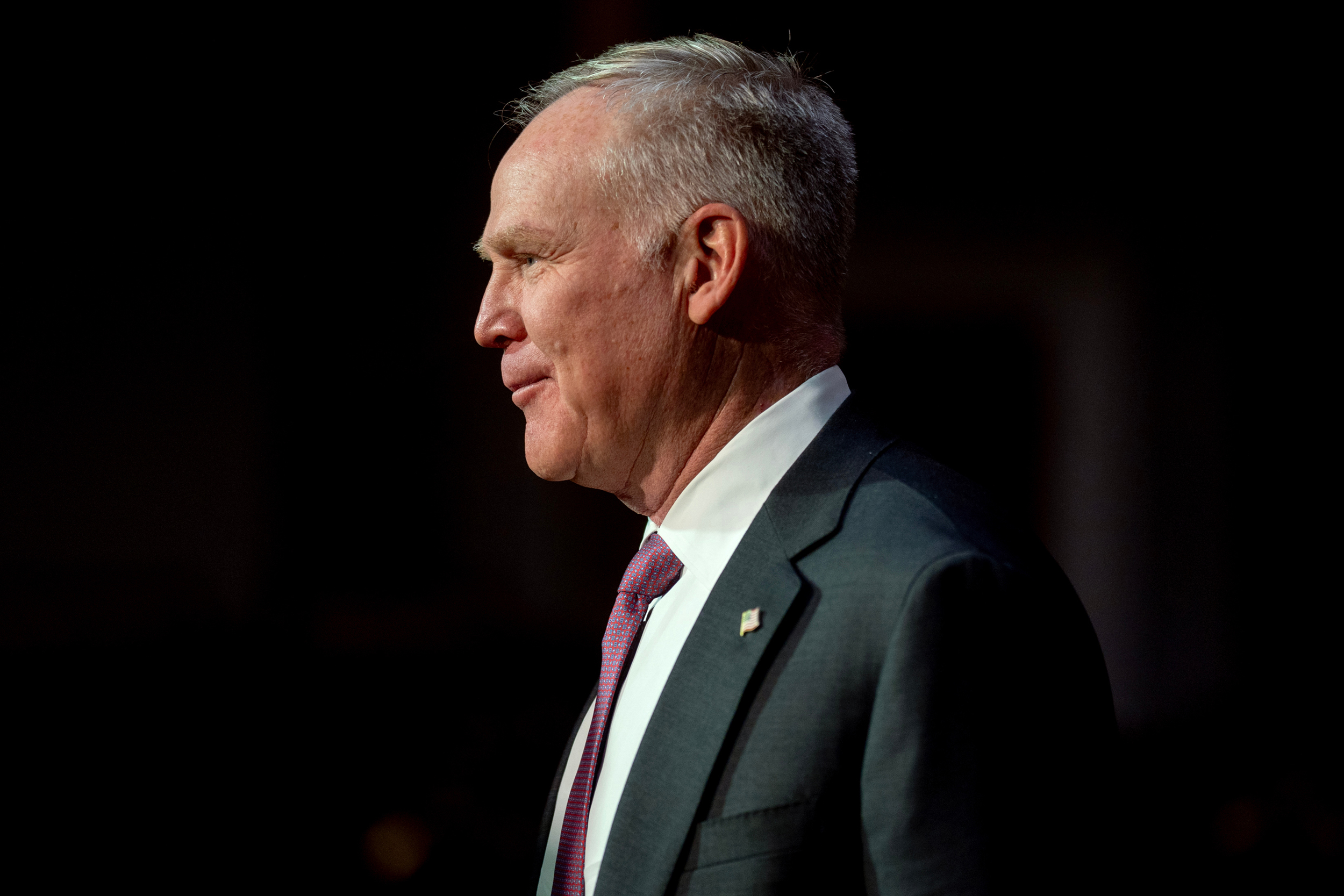
Alan Armstrong of Oklahoma entered the U.S.
Senate to fill a vacancy in March with a clear priority: pass permitting reform that he argued was necessary based on his experience leading a major natural gas pipeline company.
Now, as he prepares to leave office, that goal is within reach—with big potential benefits for the company and him personally.
The bipartisan permitting bill slated for a vote next week would overhaul regulations for building all kinds of projects.
But it also includes provisions Armstrong promoted that could push through a disputed pipeline that the Williams Companies, his former employer, has tried to build through New York for more than a decade.
When state regulators denied a water quality permit for the Constitution pipeline in 2016, it was a rare rebuke for an industry unaccustomed to having government officials block its projects.
Provisions in the new bill would limit New York’s authority to deny it again.
Williams is now asking federal regulators to revive their approval of the pipeline from more than a decade ago.
Armstrong continued to hold at least tens of millions of dollars in Williams stock as of Oct.
22, according to his most recent financial disclosures.
He also hired three former Williams colleagues to his staff, one of whom maintained his role as senior vice president and general counsel at the company while temporarily serving as Armstrong’s chief of staff in the Senate.
The Bipartisan American Affordability and Jobs Act would greatly restrict states’ and tribes’ ability to deny or place conditions on water quality certifications.
The bill would also make other changes to accelerate approval of Constitution and other pipelines, including restricting judicial review and scaling back certain environmental reviews.
Environmental lawyers say changes to what’s known as a Section 401 certification of the federal Clean Water Act appear tailored to help a small number of gas pipeline projects.
One of the companies that would benefit most is Williams, where Armstrong served as chief executive and chairman for 15 years until his appointment in March by Oklahoma’s governor to fill a vacated U.S.
Senate seat.
Williams has already received extraordinary support from the Trump administration.
President Donald Trump claimed he made a deal with New York Gov.
Kathy Hochul to get the Constitution pipeline built, which she denies.
Environmental Protection Agency Administrator Lee Zeldin has pledged support for the pipeline, and his agency is finalizing a rule change that would restrict states’ and tribes’ ability to condition permits in order to safeguard water quality, similar to the permitting bill.
In October, the U.S.
Department of Energy said it would devote up to $42 million under the Defense Production Act to pay permitting costs for the project.
Armstrong’s office did not respond to questions for this article, though he has frequently criticized what he calls a broken regulatory system that drives up costs.
“When every pipeline, transmission line, power plant and industrial project is treated as something to stop rather than something to build responsibly, the costs do not disappear,” Armstrong said in a Senate speech in July.
“They accumulate slowly, until families are paying more, reliability is deteriorating, and investment is moving elsewhere.” Williams spokesperson Blake Jackson said the company supports the permitting bill “and all its provisions to provide a tech-neutral and level-playing field for all energy infrastructure.” Some residents of upstate New York see things differently.
A Threat to State Waters Anne Marie Garti, a lawyer who owns a home near the Constitution pipeline route, fought the project the first time around.
From the start, “there was a huge amount of opposition,” Garti said, “and skepticism.” The Constitution project would run 125 miles from the Pennsylvania shale gas fields across upstate New York, eventually connecting to other interstate pipelines.
The Federal Energy Regulatory Commission, also known as FERC, oversees interstate gas pipelines.
But states retain authority under the Clean Water Act, which requires energy companies like Williams to apply for water quality certifications.
Garti called these permits the “weak link” in the regulatory process.
Taking inspiration from an earlier permit denial in Connecticut, she and other residents focused their fight on the pipeline’s potential effects on 251 streams along its route.
State regulators said 87 of those streams provided trout habitat.
Building the pipeline would require digging trenches across streams, diverting their flow and clearing trees and brush along their banks.
The work would send sediment into clear waters, raise temperatures and temporarily damage habitat for trout and other species, according to the New York Department of Environmental Conservation’s 2016 denial.
State regulators rarely reject water quality permits, which are needed not only for pipelines but many federally regulated projects.
In a recent survey of 24 states by the Association of Clean Water Administrators, no state reported a denial rate higher than 3.5 percent—most said they’d never denied a permit.
New York denied the certification for Constitution in 2016, saying the company had failed to address the project’s water quality impacts and had not provided sufficient proof that Williams would comply with state standards.
The denial kicked off years of legal wrangling.
In 2020, Williams said it would not pursue the pipeline and a federal appeals court ruling later vacated the federal permit.
Another permit denial followed in 2019 for a second Williams project: the Northeast Supply Enhancement (NESE) pipeline that would have run from New Jersey across the New York harbor.
A few other pipeline proposals in the Northeast and mid-Atlantic faced similar fates, while in some cases regulators imposed conditions to protect waterways.
The bipartisan permitting bill would severely limit states’ ability to impose these restrictions in the future.
Currently, states or tribes can consider the full scope of how pipeline construction and operation would affect waterways—for example, how clearing trees could increase erosion on banks, or how contaminated runoff could enter the water.
The permitting bill would limit states to considering only direct discharges when reviewing projects.
It would also shift the burden of proof.
Instead of requiring pipeline companies and other developers to show their projects would protect water quality,....