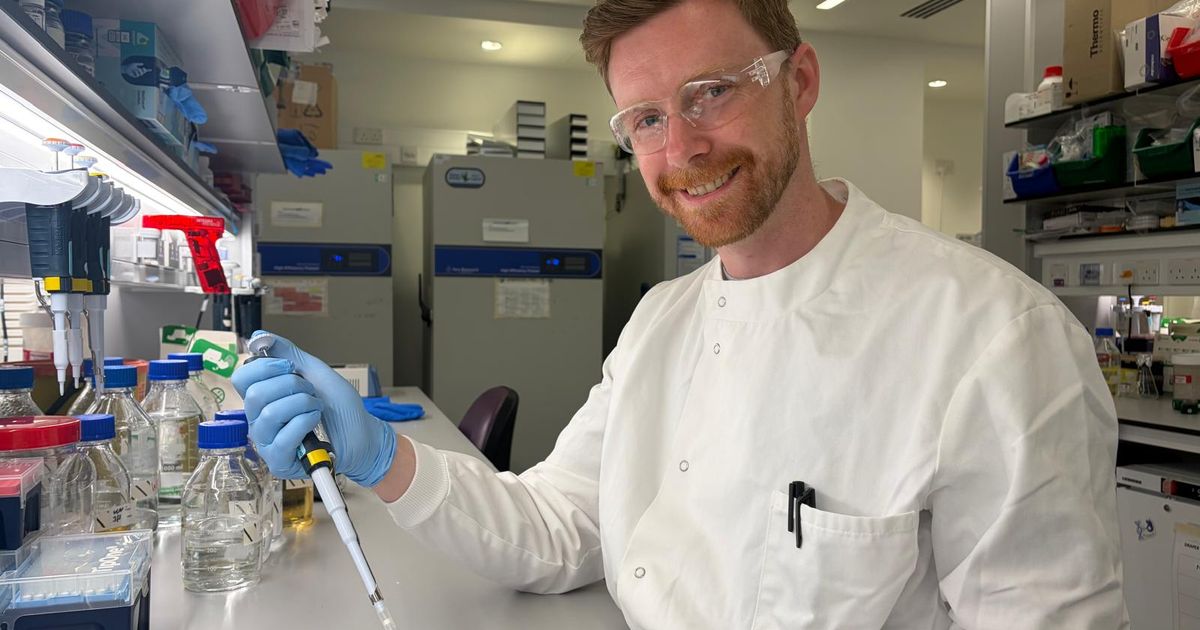
It was during his A-levels that Barney found an interest for infectious diseases.
‘I was at Elizabeth College in the 2000s and I remember I really liked the biochemistry part of biology – which I don’t think anyone else really enjoyed that much,' he said.
'I think because you cover so much content in your GCSE and A-levels, they obviously can’t go into too much detail, so they would say things like, “Oh, this cell signals to another cell, or this cell tells this cell how to do something,” and for me, I really wanted to know how a cell does actually talk to another cell, how does that actually work?' ‘I think it was looking at diseases in A-level biology – infectious diseases in particular – that I wished we could do more of it.
Unfortunately, we then had to move on to ecology, which I did not enjoy – lots of standing on the shore counting seaweed, which now sounds like a great afternoon – but as a 17-year-old, that wasn’t that exciting.
‘I was really fascinated about different diseases, how they invade the body, what they do to you and how you can stop them.’ Barney’s interest in diseases grew during a year in America as part of his biochemistry degree at the University of Bath.
‘I worked at the University of Georgia infectious disease unit in their veterinary college and I worked on worm parasites – nematodes – and I think that’s really where I got into tropical diseases and parasites in particular, because I just found them really fascinating,’ he said.
‘From there I did a masters in microbiology at Bath and I then went to Oxford actually to work.
I worked for a biotech company for two years doing gene therapy and then after that started my PhD at the University of Oxford working on malaria vaccines, and I’ve been there for nine years.
‘It was a bit of a last-minute decision to go to America.
The opportunity arose and I remember I was sitting with a friend and we were both, “I’ll go if you go” – we both weren’t sure.
We both went to different labs and I think I picked it because the project was on these parasites and it had a real-world application.’ After developing the vaccine – which is now in clinical trials – for his PhD, Barney has been working out how that vaccine works and will now focus on redesigning it to make an improved version.
‘Malaria has been around forever.
There was about 280 million cases in 2024 and there’s about 600,000 deaths each year, so what we want to do is basically stop people dying and stop people getting infected with malaria,’ he said.
‘Malaria has a reasonably complicated life cycle.
One part of that life cycle....