In June, Defense Secretary Pete Hegseth visited White Sands Missile Range in southern New Mexico.
This stretch of desert had been a proving ground for barely a week when, in 1945, Manhattan Project scientists detonated the first atomic bomb at its Trinity Site, releasing the destructive energy of nuclear fission.
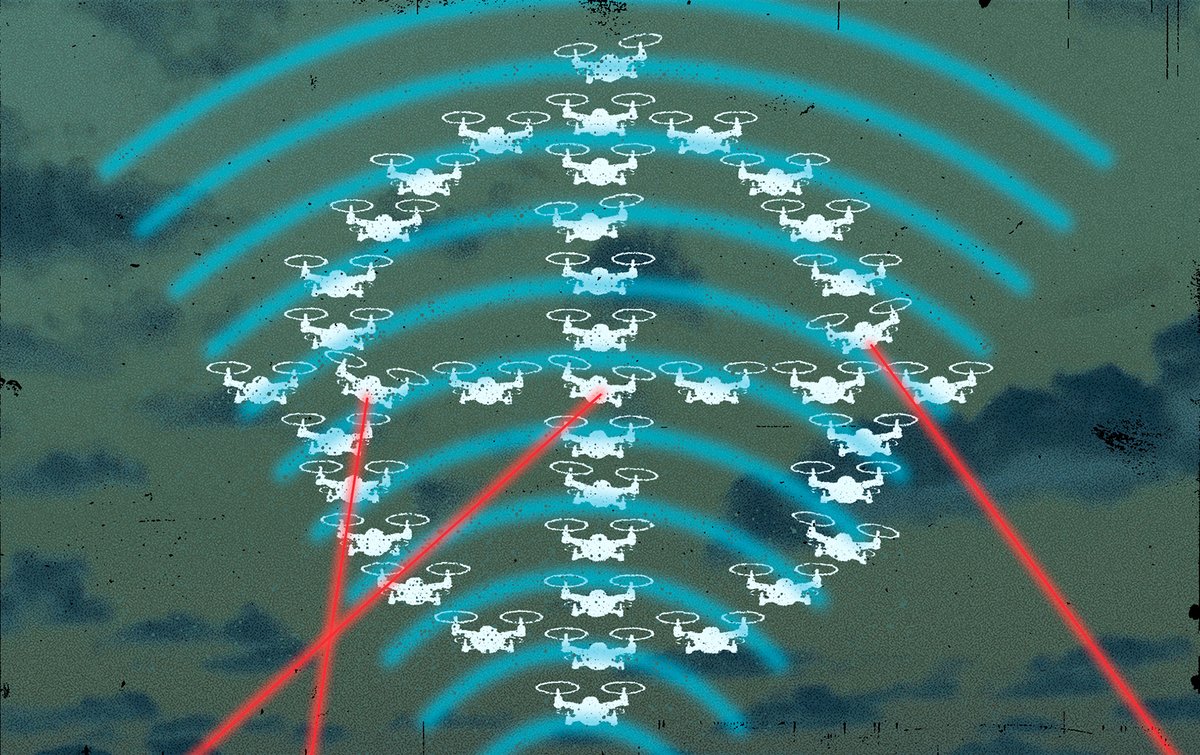
Nearly 81 years later White Sands hosted a different experiment in concentrating electromagnetic energy: a demonstration of lasers and high-power microwave weapons designed to take down drones.
When operators fired a U.S.
Army prototype based on Epirus’s Leonidas system at a swarm of 12 drones, all of them dropped from the sky.
Invisible microwaves had disrupted the electronics that kept them aloft.
Hegseth himself took control of another system, called LOCUST, and used its high-energy laser to defeat a drone.
Directed-energy weapons have long been more promise than combat reality, with technologists dreaming big yet fielding few systems.
Cheap drones might have given them a practical use.
On supporting science journalism If you're enjoying this article, consider supporting our award-winning journalism by subscribing.
By purchasing a subscription you are helping to ensure the future of impactful stories about the discoveries and ideas shaping our world today.
Drones can gather intelligence on troop movements and strike those troops.
But traditional U.S.
defenses do not always match the threat.
Drones are now inexpensive and ubiquitous; the missiles used to take them out are often much costlier and limited in supply.
A defense can work while losing the economic and logistical contest.
“The protectors—which are built to hunt lions or elephants—are getting kicked in the butt by the mice,” says Andy Lowery, CEO of Epirus.
“Mice are coming in, and so what we do is we defend against mice.” He hopes Epirus’s microwaves can provide that defense—a mousetrap, he calls it.
The Pentagon knows it needs a solution to the mouse problem.
Drones are central to the wars in Ukraine and across the Middle East.
They’re also a stateside threat: anyone can buy them online and send them toward a military base or large gathering.
“Small unmanned systems are a defining threat for our time,” says Army Lt.
Adam Scher, quoting General Matthew Ross.
“They are prolific, they’re evolving quickly and they’re no longer confined to combat.” The aircraft dotting the sky simply stopped and fell nearly in unison, like dancers dropping on cue.
In August 2025 the Defense Department established Joint Interagency Task Force 401, a unit dedicated to counterdrone innovation.
Scher is its strategic communications adviser.
Directed energy—lasers that burn through drones’ hardware and microwaves that essentially fry them—is part of the unit’s strategy.
Task Force 401 has selected five U.S.
bases, in Arizona, Texas, Washington State, North Dakota and Missouri, for a directed-energy pilot.
According to Scher, the program will let operators give feedback on the systems’ performance and help to shape future doctrine and training.
It will also help the military coordinate with the Federal Aviation Administration when using lasers and microwaves in domestic skies.
Scher says the task force is working hard to get directed-energy systems into the field “rapidly.” In February, Customs and Border Protection (CBP) used LOCUST near Fort Bliss in Texas against what officials believed was a threatening drone.
The object might have been a Mylar party balloon.