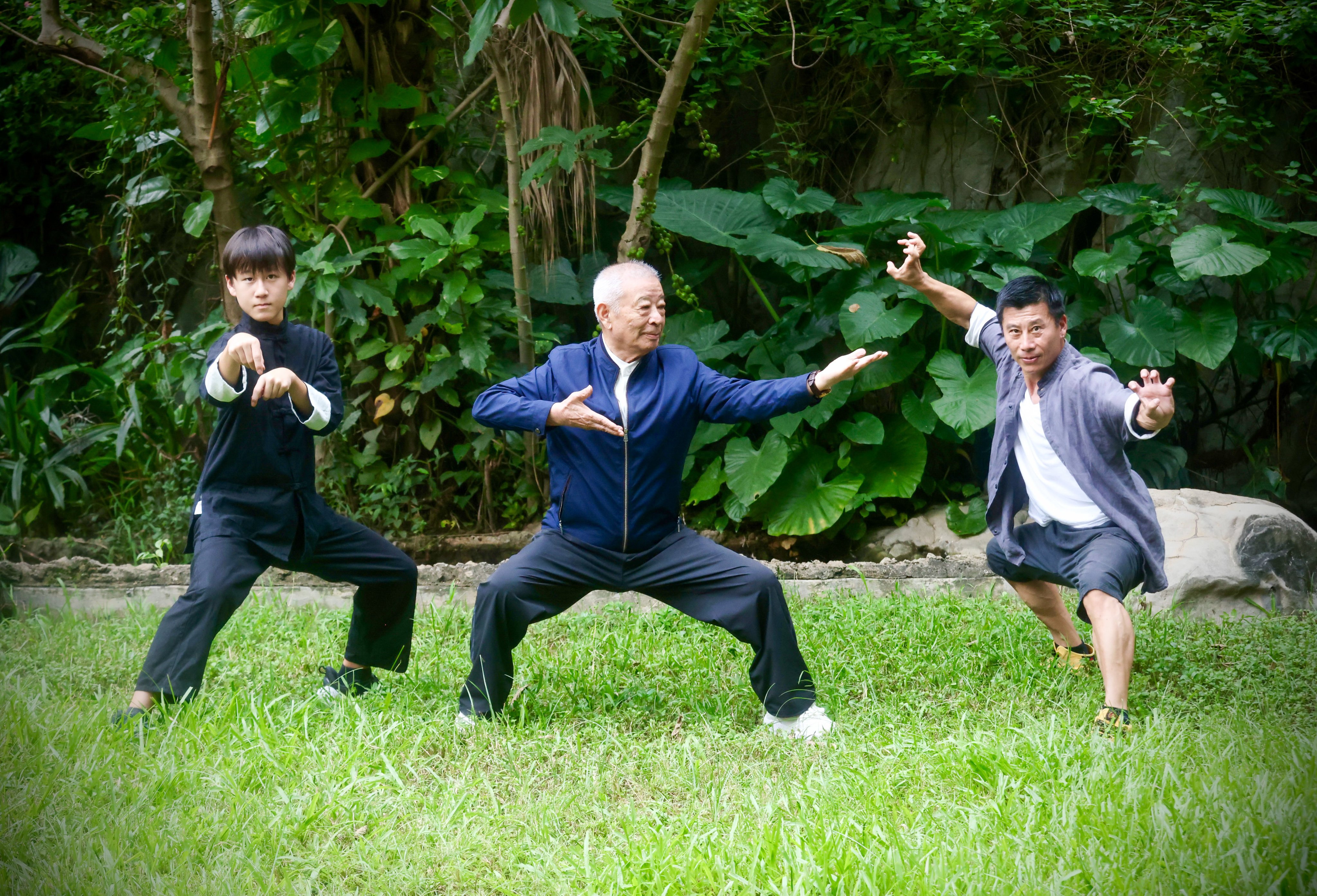
At 89, many rely on glasses or hearing aids.
Wu Bin needs neither.
Daily runs and regular football games keep the legendary martial arts coach of action icon Jet Li in fighting form.
Wu is a convincing advertisement for the wellness benefits of lifelong discipline.
He still travels widely and recently presided over the 18th Hong Kong International Wushu Competition, where Dragon He, the son of another of Wu’s former students, Jaden He Jingde, was competing.
A founder of the Beijing Wushu Team, Wu helped develop the traditional martial art into an elite modern sport.
His eye for potential led him to the eight-year-old Li in 1971 and helped launch his career.
Li’s mastery of Chinese martial arts would elevate him to the podium at championships and launch him onto cinema screens around the world.
Today, Wu’s impact extends to a third generation of disciples.
Rather than retire, he travels to encourage them.
Wu was born in Huzhou, in China’s Zhejiang province, in 1937.
His family fled to Shanghai during the Second Sino-Japanese War, when Wu was around two years old.
His father made bricks, including those used to build Shanghai’s historic Park Hotel, which for years was Asia’s tallest building.
If you imagine Jet Li’s master as a mystic elder armed with wushu’s deepest secrets, think again.
“It was only after primary school that I liked reading martial arts novels,” Wu says.
“I was most captivated by the stories of various combat styles.” Books such as Water Margin and The Seven Heroes and Five Gallants, which featured themes of brotherhood, martial prowess and rebellion against injustice, stirred his imagination – but he had yet to throw a punch.
From weightlifting to wushu Wu boarded at Shanghai High School, where he served as captain of the football team for about half a year.
A teacher recommended he train as a PE teacher.
Wu had been offered early admission to Shanghai Teachers College when a chance bicycle ride changed his plans: he saw an advert for the Beijing Institute of Physical Education – now called Beijing Sport University – and decided to sit its entrance examination.
He was accepted into the institute in 1958 and started weightlifting.
Two years later, a teacher encouraged him to diversify.
“You’d better stop practising weightlifting,” Wu remembers being told.
“You’ve done it for two years, and that’s enough.
Learn martial arts instead.” The teacher reasoned that weightlifting equipment would not necessarily be available to a future PE teacher, but martial arts could travel anywhere.
Wu followed the advice and retrained as a wushu coach in Beijing after graduation.
Having watched older pupils pulled away from sport by academic pressures, he decided to recruit younger children.
In 1970, he began visiting primary schools.
Among a group of prospective recruits at Beijing’s Changqiao Primary School, one boy stood out: Li Lianjie, who would later become known as Jet Li.
Wu remembers that Li was unusually quick for an eight-year-old.
“His memory was excellent, and his ability to mimic movements was very strong,” Wu says.
“Whatever you taught him, he learned very quickly.” Li was one of around 10 children Wu coached into adulthood.
A cultural calling card Warming relations between the United States and China in the 1970s triggered a rise in martial arts.
US President Richard Nixon’s landmark 1972 visit to China ended 25 years of diplomatic....