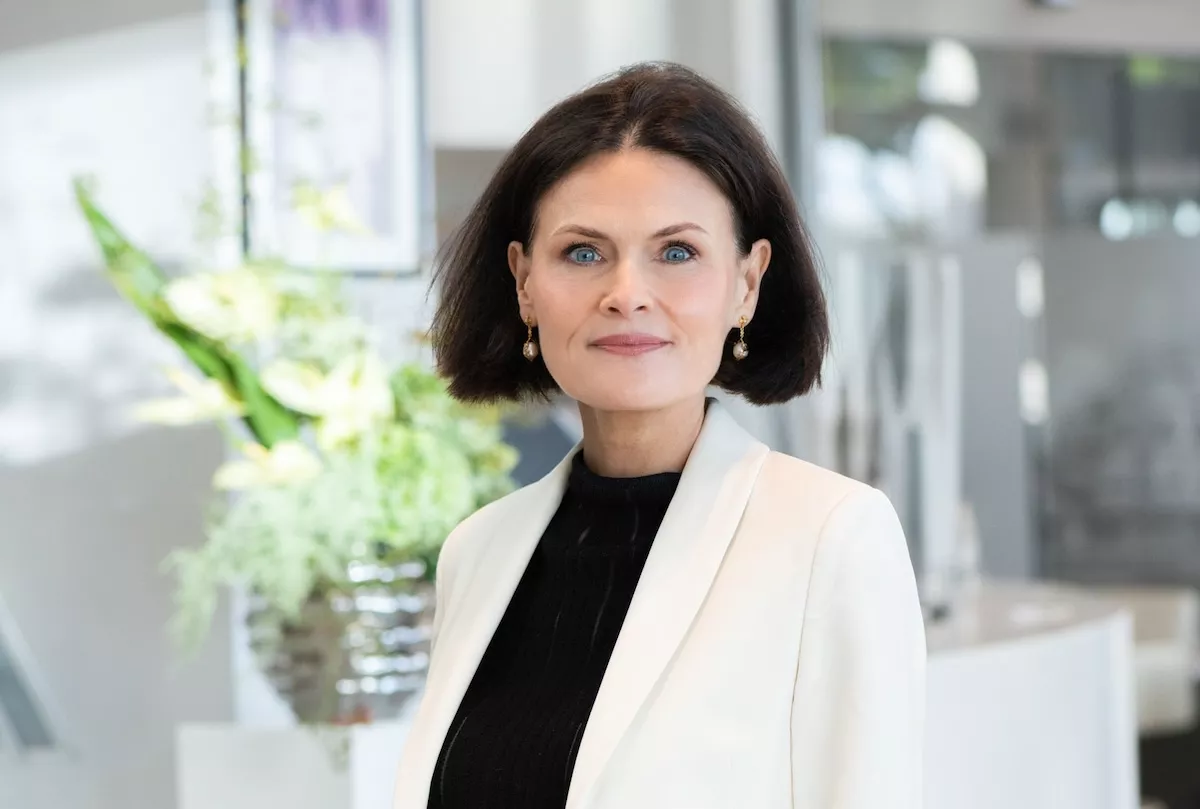
Almost a year after taking the helm of CFM Indosuez Wealth Management, Monaco’s only listed bank, Bénédicte Chrétien faced the press for the first time on Tuesday — and she did not do it alone.
Rather than address the room from the front, the chief executive sat surrounded by her senior leadership team and handed each of them the floor in turn.
It was a deliberate signal of the more collaborative way she intends to run a 104-year-old institution now navigating some of the deepest changes its industry has faced.
Bénédicte Chrétien, who took over last October from Mathieu Ferragut, arrived after more than two decades in wealth and asset management and, most recently, a spell as group head of human resources at Crédit Agricole — the people-first background that colours much of her thinking.
Chrétien’s new strategy sets out six priorities for the bank, with ‘Client at the Heart’ at the top of the list.
It calls for a more integrated advisory model in which the private banker acts as a conductor, drawing together an increasingly specialised orchestra of experts for each client.
Not a pyramid, but a collective Chrétien was emphatic that the bank is no longer led from a single desk.
Its executive committee has been renewed by 80% since she arrived — younger, and now 62% women — and she framed that collective as the point rather than a by-product.
“This bank is not run by one man or one woman alone,” she said.
“There is no providential man or woman.
There is a team that, through the diversity of its experiences, profiles and skills, balances itself positively.” Bringing that team to the microphone, instead of speaking for it, was the demonstration.
A clientele in transformation The urgency, as Chrétien tells it, comes from three shifts striking wealth management at once.
The first is the great wealth transfer: by 2030, she said, around 30% of the world’s wealth will change hands, half of it in the United States and a quarter each in Europe and Asia.
The second is a new generation of clients who want more than returns.
“How can my wealth have an impact on the world — now, but also in 20 or 50 years?” is the kind of question they now ask, she said.
The third she called genuinely new: the rise of women’s financial power.
In 2015, women held 31% of global wealth; by 2026 that had climbed to 41%.
It is a shift mirrored in the bank’s own leadership, with a female chief executive and deputy chief executive, and an executive committee that is now majority women.
Where the priorities of the next generation and of women converge, Chrétien argued, is on a demand for meaning and measurable impact.
It is this that she brands “the bank of meaning” — the case that preserving and growing family wealth must now sit alongside purpose, from the blue economy to sustainable building and education.
The human, augmented by technology On technology, Chrétien was pointedly unromantic.
Artificial intelligence, she said, is now simply the norm — every bank will have it — so it cannot be what sets one apart.
“The real differentiator is the human being augmented by technology,” she said, reaching, for her largely Anglophone audience, for a line she attributed to Steve Jobs: “I would trade all of my technology for an afternoon with Socrates.” Sophie Couve de Murville, the bank’s Global Head of Advisory, explained what this looks like in practice.
AI already allows the bank to produce instant consolidated reporting across complex structured-product positions and monitor more market signals than any analyst could track alone.
During one recent client review, she said, the technology revealed that a portfolio which appeared well diversified was actually heavily concentrated in technology once its underlying US and Asian exposures were analysed.
Yet even within her own field, she added, AI still combines “extremely advanced” analysis with “beginner’s errors”.
“What still makes the difference is intuition – particularly an understanding of how markets will react,” said Couve de Murville.
“At this point,....