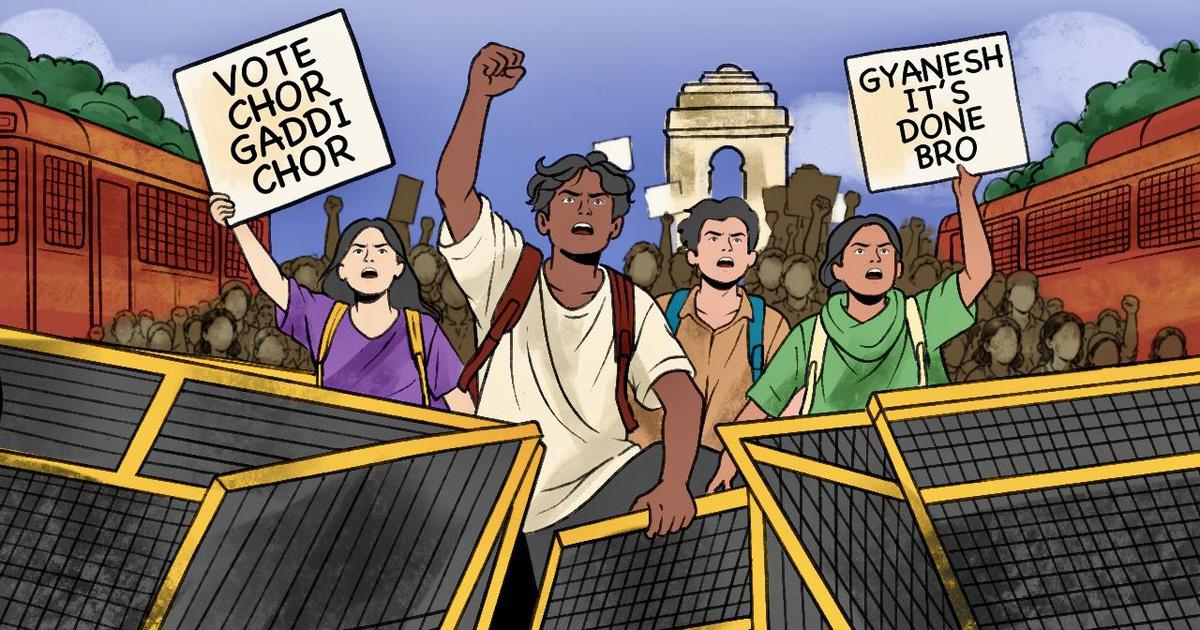
At around 2 pm on October 2, around one hundred students from the All India Students’ Association made an attempt to reach Jantar Mantar in Delhi.
The protestors were demanding the resignation of Chief Election Commissioner Gyanesh Kumar over irregularities in the Special Intensive Revision of the electoral rolls.
As they approached, they chanted, “Vote Chor, Gaddi Chhod!”, vote thief, leave your seat.
Delhi Police personnel intercepted the group and began to chase protestors in an attempt to detain them.
The protestors dodged the police.
“Dilli Police wardi kholo, RSS ka knicker pehno!” they chanted as they ran.
Delhi police take off your clothes, put on RSS shorts.
Among the students was Sahil, a 17-year-old first-year student of sociology from Hindu College.
“I was part of the group that broke through two sets of barricades to reach Jantar Mantar,” said Sahil, who asked to be referred to by a pseudonym.
“We were detained near the third one.” In the throes of the protest, Sahil said, he was beaten by the police and suffered some bruises.
The police herded Sahil and protestors onto a bus, and drove them in circles for a few hours, before finally releasing them close to Delhi’s border with Haryana.
“My hands were shaking throughout the bus ride even though I knew from beforehand that we were only going there to get detained,” said Sahil.
From the border, Sahil took a bus and a metro and reached home around 9 pm.
His parents had no idea that he had been detained or even taken part in the protest.
“I had told them that I would be home late because of a cultural event at college,” he said.
This was the second time in five months that Sahil stepped out to protest.
In June, Sahil had joined thousands of other youth at Jantar Mantar in protests led by the Cockroach Janata Party pressure group to demand the resignation of the education minister Dharmendra Pradhan over irregularities in the national exam for medical college seats.
Sahil has been participating in agitations even though he knows this family would probably disapprove of his actions.
“Most of my relatives are teachers whose understanding of education has always been apolitical,” he said.
“My parents believe politics exists outside of the domestic sphere.
They think kids should not be involved in protests, as they will only be used by political parties for their own ends.” Despite this, Sahil said he had felt a growing sense of frustration and anger against the union government for several years.
He decided to start giving vent to these emotions when he learnt about the Cockroach Janata Party’s protests in June against the leaks of the papers for the National Eligibility cum Entrance Test for medical colleges – this despite the fact that he is a student of a different discipline.
“The starting point was indeed NEET,” he said.
“But it’s the nature of protests that as more people join, the spectrum of issues also expands, and there are so many issues that people are angry about.” Sahil’s account of his decision to participate in the protests captures something of the present moment of tumult in the country, in which young “Gen Z” protestors have taken to the streets in huge numbers.
Scroll spoke to ten young protestors in Delhi and Mumbai to understand how their worldviews were shaped and what had drawn them to the streets.
Six of the ten said they had been manhandled or detained by police during the protests.
Like Sahil, most said they had felt anger build up over time as a result of several crises.
Apart from the NEET paper leaks and the contentious SIR, they also mentioned what they saw as the government’s mismanagement of the Covid-19 crisis and its decision to push through the Citizenship Amendment Act and to announce a National Register of Citizens.
Many were also frustrated by the government’s ineffective education reforms and the damage these are doing to the education system, as well as rising unemployment, and an increasing dilution of personal and political freedoms.
“A lot of people did come because of the education system and everything that's wrong with it,” said Vanessa, a political science student in Delhi.
“But I went because of the larger issues that we have faced as a country in the past 12 years.” She added, “I recently turned 21, so these protests were the first time where I felt like I could participate in dissent and express my own dissatisfaction with the government.” While the young protestors have displayed great courage, they are also aware of the real risks they face by voicing their dissent on the streets.
“I am really scared about it.
I am not gonna lie,” said 18-year-old Shubhi Singh, a student of Hindu College.
“But if I don’t stand up today, I am more scared of how things will only get worse in the future.
What kind of world will we leave for the next generation?” Personal experiences and political consciousness Like with Sahil, three other students Scroll spoke to said their parents were also totally unaware about their involvement in the protests.
Many of the students asked to be identified only by their first names.
Some asked to remain anonymous.
Eighteen-year-old Khiteesh said that his parents do not know that he was brutally lathi-charged on July 20, or that he has been detained by the police four times since July.
On two of these occassions, he jumped out of the bus to escape detainment.
Khiteesh who studies at Ambedkar University Delhi, belongs to a right-wing upper caste business family in eastern Delhi.
“My parents are proper saffronised fascists,” he said.
“We rarely talk about politics, but when they do talk about it, they are always like Modi is so great, he is a saviour of our religion.” He added, “They know that our economy is not doing that well, that prices are rising quite fast.
But they don’t care about all that.” Vaishnavi Sonawane, a 26-year-old, lives in Mumbai, and has participated in protests in the city.
She also travelled to Delhi for the protests in July, and again in October.
On the latter visit, she said, she was manhandled by the police.
Her parents, who live in Gujarat, do not know about her political activities.
Despite this absence of political engagement in their families, many young people told Scroll that they grew interested in politics because of the various government policies and decisions that had hurt them over the years.
Some of these played out before these young people became adults.
In 2020, for instance, Vanessa was studying in school in Lucknow when the Covid-19 pandemic hit.
When her father, who had a government job fell ill during this period, Vanessa remembers that her family desperately hunted for an oxygen cylinder.
“My dad was in need of pretty serious medical help,” she said.
“We finally managed to admit him in what was the last vacant hospital bed in Lucknow, I think after three days.” Vanessa added, “And this was for someone coming from substantial privilege.
I can only imagine what the other people went through.” This experience and her wider conclusion that the government had mismanaged the pandemic “radicalised” her, she said.
“I had always known there was something wrong with the government, but after that I was like this government has to go,” Vanessa said.
“They had the resources to prepare, but they didn’t.” Khiteesh too said that the Covid-19 pandemic shaped his political ideology.
Though he was not seriously impacted personally, he keenly remembers the struggles of his fellow citizens during that time.
“I was horrified to see how common people were suffering on my socials,” he said.
“Covid really exposed the inequality in our country.” During this time, he also noticed communal discrimination by the authorities in his own neighbourhood when it came to helping ordinary families.
“I live in an area dominated by Jain and Brahmin families,” he said.
“But just next door there is a Muslim majority community and I remember how they were struggling to dispose of their dead.” In some instances, earlier waves of protest sowed seeds of dissent in young people, who took to the streets in the recent agitations.
“Before 2022, I wasn’t that interested in politics,” said 22-year-old Mohammed Akram, a resident of Loni, in Ghaziabad.
But when the CAA-NRC protests played out in 2019, “I remember thinking that the government wants to remove minorities from living in the country and put them in camps where they won’t even have basic facilities”, he said.
This sentiment stayed with Akram over the years, and earlier this year, he gave voice to it on Delhi’s streets.
In fact, he went further than most.
Akram used to work as a hairdresser until June, but quit his job then to participate in the Jantar Mantar protests and work as a full-time organiser for the All India Students Association.
Some young people, from marginalised caste, religious and gender groups, explained that their political leanings were deeply entwined with their community identity.
Vanessa, who is from an Adivasi community said, “Both my parents instilled a sense of community identity in me, as we were raised outside of our native place.
So ever since the NDA [National Development Alliance] government came into power in 2014, I have known that it was bad for our people.” Twenty-year-old Karishma, a 20-year-old literature student who asked to be referred to by a pseudonym, explained that her Christian identity was crucial to her political development.
“I don’t want to claim that Christians get the same kind of hatred that Muslims do,” she said.
“But there is a lot of marginalisation toward Christians that often gets ignored and it is definitely one of the things that has politicised me.” She....