The respite after the Iran war has failed to restore strategic stability in the Middle East.
Renewed Saudi-Houthi hostilities expose the fragility of the region’s security architecture, threatening global energy supplies and trade.
Yet the deeper danger is geopolitical.
The region’s predicament is no longer simply about competing military capabilities.
It concerns the erosion of the international order, the weakening of conflict-resolution mechanisms and the growing race of promoting self-interests.
More troubling, the crisis is unfolding in a world where those capable of containing conflict may be less willing to intervene than some who stand to benefit from disorder.
The most disturbing feature of the present crisis is the imbalance between those who can destabilise the region and those expected to restore order.
The Gulf is discovering that a pause in hostilities is not peace.
Renewed Saudi-Houthi tensions have revived the prospect of another prolonged confrontation, placing energy infrastructure, maritime commerce and regional investment at risk.
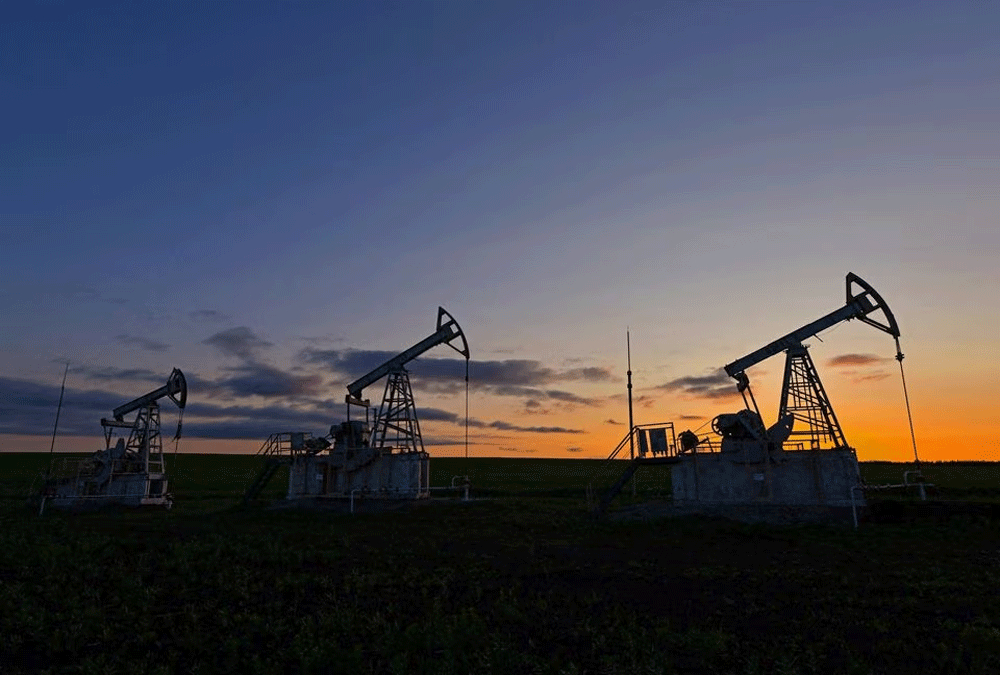
The Strait of Hormuz carries roughly one-fifth of global petroleum consumption, while the Red Sea and Bab el-Mandeb connect Gulf producers to European and international markets.
Saudi Arabia’s East-West pipeline provides an alternative route to Yanbu, but its strategic value diminishes if Red Sea shipping is also threatened.
This geographical vulnerability has global consequences.
Attacks on energy infrastructure or disruption of either maritime corridor could raise oil and gas prices, increase insurance premiums and freight costs, and reignite inflation.
Even without a sustained physical shortage, uncertainty alone can add a geopolitical risk premium to energy markets.
The consequences would extend to electricity, fertiliser, manufacturing, and food prices.
Energy-importing economies, particularly those with limited fiscal space and foreign exchange reserves, would be disproportionately exposed.
The Houthis can impose disproportionate costs through relatively inexpensive drones, missiles and threats to shipping.
Iran’s regional relationships add strategic depth to the confrontation, although the Houthis retain their own interests and agency.
Other regional actors may exploit the distraction to advance territorial, political or strategic objectives.
In such an environment, even limited hostilities can attract additional participants with little incentive to facilitate a settlement.
The fixers, by contrast, must bear the costs of containment.
Saudi Arabia must protect its population and energy infrastructure while avoiding another open-ended campaign in Yemen.
The United States and other Western powers must balance freedom of navigation, energy security and military commitments against competing global priorities.
Regional governments must contain the damage to their economies without being drawn into a wider war.
This asymmetry favours the spoiler.
Disruption is relatively inexpensive; restoring confidence, securing shipping and rebuilding damaged infrastructure can cost billions.
A spoiler needs only to keep uncertainty alive, whereas a fixer must deliver a durable settlement.
The danger is compounded by the absence of a credible regional security framework capable of reconciling competing interests.
Military deterrence can impose costs, but it cannot substitute for a political settlement.