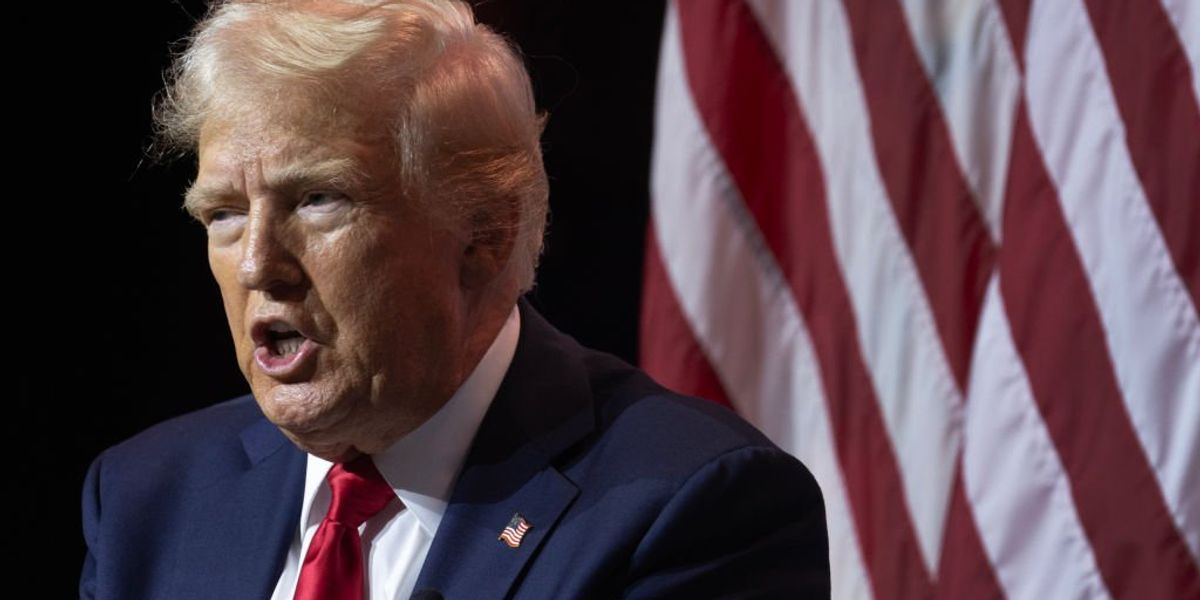
Editor's Note: This article was updated to correct the word "expansive" to "expensive" in the sentence, "AlterNet had an expansive conversation with Wolff." President Donald Trump has permanently destroyed both America's working class and its standing in the global community, according to an expert economist who spoke exclusively with AlterNet.
Wolff, professor emeritus of economics at the University of Massachusetts Amherst, made it clear in his Thursday afternoon interview that America's elites and ordinary citizens alike are in mass denial about these realities.
They continue to remain in this denial at their own peril, he added.
Trump's destruction of long-term trade alliances have prompted former US partners to seek better deals elsewhere, slowly but permanently restructuring the global economy against our country's best interests.
Similarly, the Republican Party's indifference to working class woes — perhaps best embodied by Trump's focus on issues of personal interest only to himself and his supporters (renaming the Kennedy Center to include "Trump," building a White House ballroom) and dismissing efforts to build affordable housing as a "yawn" — guarantees that mainstream economic concerns will be inadequately addressed, if they are indeed meaningfully confronted at all.
To learn more, AlterNet had an expansive conversation with Wolff.
The following interview has been lightly edited for clarity, context and length.
ROZSA: I want to start with a comment that President Trump made in June.
He was asked by reporters whether he would sign affordable housing legislation, and his exact words were, "It hasn't been sent to me yet.
It's coming.
I understand.
And then I'll make a de - Here's what I would like to say.
It's a yawn." What are your thoughts about Trump describing affordable housing legislation as a quote unquote yawn? To what extent does that reflect on the Republican Party as a whole? WOLFF: Yeah, I think the Republican Party, like Mr.
Trump, when it's convenient for him to go along with the Republican Party, which it often is, but sometimes in a very demonstrable way, it isn't.
He has his own agenda.
It's not exactly the same.
But in this case, it is the same.
It's a notion that the private sector, in this case, the private sector that constructs housing, is to be left to make the decision of whether or not to build houses for the American people.
And if so, which people.
And we have a hard economic reality, which the president no doubt knows, which is that for the last 14 years, the inequality in the United States, the gap between rich and poor, has become steadily more and more extreme.
And markets follow where the wealth is.
That's how markets work.You produce where you can get the most profit.
That's the way the system is set up.
Rich people have the money to buy expensive housing.
So that's the housing that the private sector builds, because it's profitable.
What they don't build is housing that's affordable for middle and low income people, because it is either less profitable or not profitable at all.
And at a time when you have record high interest rates, and remember, corporations are borrowing money all the time.
They have to pay more to borrow more.
It's expensive to borrow money.
Lumber, because it comes from Canada, is now more expensive in part because of tariffs Mr.
Trump put on, and the whole reorganization of the Canadian economy to rely less on the American economy makes the cost of lumber that much higher.
You're facing a situation where the costs of housing are rising, and therefore you need to charge more and more money, and only rich people can do that.
And the result is you have inadequate housing, and you have a wild rise in rentals across the country that reflects all that, and a rising cost of owning your own home if you're gonna go that route.
Mortgages are now at a record high rate and about to go higher because of the Federal Reserve raising interest rates yesterday.
So we're gonna be seeing over 7% mortgage rates become the norm.
All of that produces a private sector focused on expensive condos in the rich areas of the country, the New York area, the San Francisco area, all of that.
And the massive housing for middle and low income people becoming pinched and becoming more and more expensive.
People, young people particularly, cannot afford a home, so they are all renters and there's not enough rental housing being built.
There's no coordinated governmental planning to handle this situation.
It's just an unholy mess.
And the response of the Republicans and of Mr.
Trump to that mess is to wait for the market to sort it all out.
Will the market sort it out? It may very well do that.
It may, in the process, shift most Americans from owning their own homes to being renters.
That process, I believe, is underway.
And that will continue for as long as this situation is maintained.
And the more the president talks that way, the more he is suggesting that they're not about to do very much, even if there is a bill passed and even if it has a provision here or there to make this situation better.
It has already lasted many years.
It needs massive intervention to deal with the problem.
None of that is on the horizon.
And I think Mr.
Trump is basically letting you know that.
ROZSA: Now I want to ask about something you said to me recently regarding our trade war with Canada.
You said that you were not surprised that our government is surprised by Canada standing up for itself.
You added, "Our government is busy strong-arming people around the world in every way that it can, militarily, economically, politically, and discovering time after time to their amazement if you take them seriously that the folks are going to resist." As Canada and the European Union and China and these other nations such as the Middle East, as they resist America's bullying, how will that impact ordinary Americans economically?Wolff: It's gonna cause Americans one kind of grief after another.
Let's go back and make sure everybody understands.
And what that meant was that the United States helped allied countries recover from the war with the Marshall Plan and things like that.
But those, the beneficiary countries, including Western Europe and Japan, were markedly contrasted with the countries that got no help at all, Russia and China being the number one examples, because of communist control in Russia, and then after 1949 also in China.
And so those countries had to make it, if you like, on their own.
They had to recover from horrific war-related damage.
I mean, Russia and China probably ranked one and two in the amount of damage done during and by World War II, before, during, and after it, as any countries on earth.
The difference was after the war, they had to rely on themselves.
They got no help.
And there's a lesson.
China is now the economic success story of this period of human history.
No country has grown faster over the last 35 years than the People's Republic of China.
And the preparation for that was what happened in the decades between their revolution, 1949, and the takeoff, if you like, in the 1980s and '90s that made them the colossus that they are now.
Here's what that proves.
If you don't work out a relationship with other parts of the world, they don't all go to sleep.
They don't all imagine that their lot in life is to be poor forever.
They go to work to replicate and to hopefully exceed whatever you've done.
The Chinese and now the Russians too are showing that that's a possible way to react.
And that is having enormous impact on the third world, the global south, as they like to be called these days.
And what the United States doesn't wanna face is what I just said.
And so it doesn't understand that as it goes about bullying other countries, demanding that they invest in the United States, hitting tariffs so that the cost to Americans to buy their goods is raised by the tax we have to give to Mr.
Trump and the Washington to have the imports come in.
As you do that, you provoke, you incentivize all the rest of the world to get around the difficulties you are imposing on them, just as Russia and China had to....