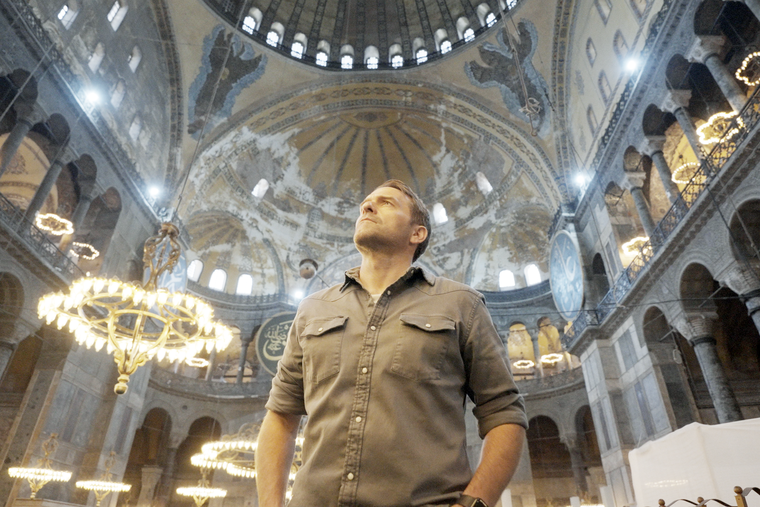
Dave Stotts of Drive Thru History is now bringing his signature style — hitting the road to explore history — to EWTN, complete with Catholic highlights, puns and, fittingly for the “Catholic Indiana Jones,” a movie reference or two.
The Road Less Traveled: Türkiye premieres Sept.
17 on EWTN+ and EWTN.com, showing across six episodes how Christianity came of age in this ancient land.
“It was here, for the first time, Jesus’ followers were called Christians,” Stotts explains of ancient Antioch (now known as Antakya).
See Acts 11:26.
Viewers accompany the intrepid traveler, seeing sweeping views of ancient ruins and Mediterranean sunsets, Roman mosaics and seaports.
Acts came to life here through the missionary efforts of saints like Peter, Paul and Barnabas.
Stotts also offers a crash course in “Turkish Coffee 101.” Then come early Church explainers.
After all, tradition holds that Peter served as the first bishop of Antioch.
Stotts takes viewers inside the cave Church of St.
Peter — it’s easy to imagine what it was like to worship here so long ago, praying at Mass with an eye on the tunnel escape route, just in case, during an era when being a Christian was truly dangerous.
Learn how St.
Ignatius of Antioch’s letters offer a profound defense of the Eucharist, before the show heads to Edessa.
“Buckle up — things are about to get a little X-Files,” according to Stotts.
First, he detours to Göbekli Tepe, an 11,500-year-old archaeological site believed to contain some of the world’s oldest religious monuments.
Then he arrives in ancient Edessa, near the traditional site associated with Abraham’s birthplace — rather than Ur in modern-day Iraq, as another tradition holds — Stotts explains, along with an aside about holy fish.
It was here, according to ancient Christian legend, that King Abgar corresponded with Jesus, asking Christ to come and heal him of leprosy.
Jesus is said to have promised to send a disciple.
Thaddeus (possibly St.
Jude Thaddeus/St.
Jude the Apostle) is then said to have come to Edessa, healed the king and preached the Gospel.
To bring home the tradition, Stotts outlines how St.
Jude imagery sometimes depicts the saint carrying an image of Jesus.
And don’t miss the portion on the lost-and-found Edessa cloth, complete with the theory linking it to the Shroud of Turin.
Moved by the Mass Episode 2 about Cappadocia is more than Turkish Star Wars (watch to find out about that cinematic link), Stotts promises viewers — and he doesn’t disappoint, descending into underground cities and cave churches filled with incredible frescoes.
Peter addresses Christians here in 1 Peter 1:1.
In this segment, Stotts discusses the birthday of the Church and the nine-day novena tradition in relation to the time frame between the Ascension and Pentecost and how people from Cappadocia were among those present at Pentecost.
And then the view transitions: Modern-day hot-air balloons float above the mysterious terrain, with Stotts in a balloon himself, surveying the sweeping vistas marked by “bizarre beauty.” Most moving is the episode’s segment highlighting how Christians used underground settlements as places of refuge and worship during periods of persecution.
The underground city of Derinkuyu was discovered during a home renovation in the 1960s.
A deep well offered fresh water for inhabitants; between the various levels and rooms, historians estimate that about 20,000 people and their livestock could shelter in the elaborate subterranean system.
An impressive network of ventilation provided fresh air.
Stables, chapels, a convent and numerous other spaces were part of this remarkable underground complex.
Nearly 200 feet underground, a cruciform church showcases crosses carved into....