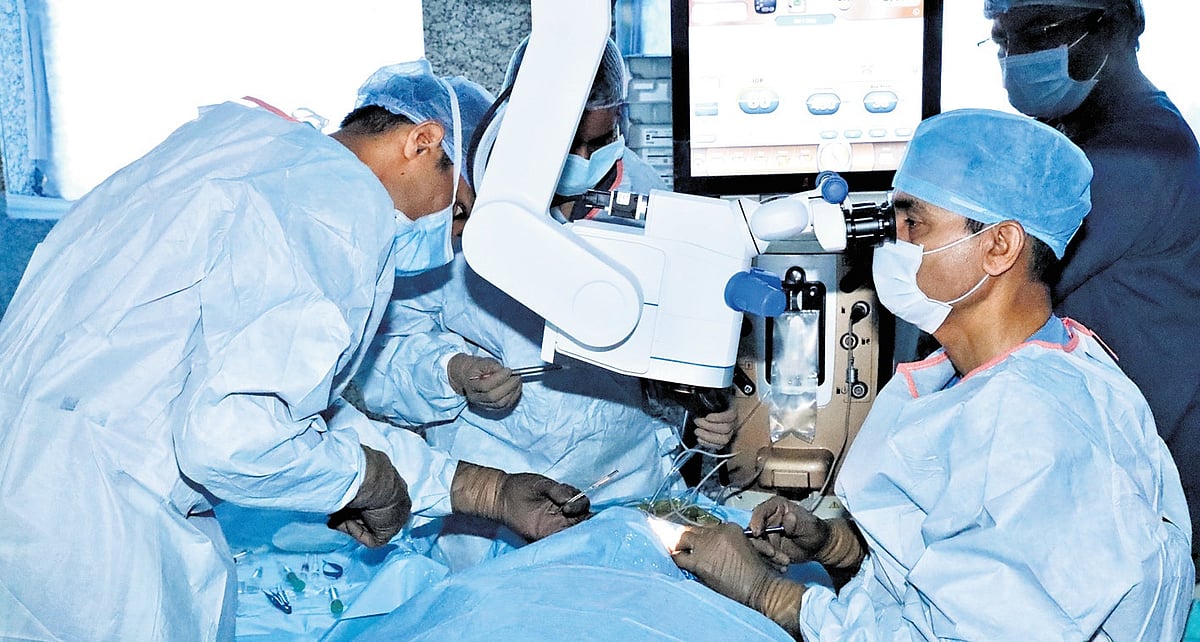
JAMMU AND KASHMIR: The Indian Army has fought a different kind of war in Kashmir—a war not against an enemy, but against failing eyesight.At an underground operation theatre near the shelling-prone Tangdhar area, close to the Line of Control (LoC), Army eye surgeons carried out 220 sight-restoring surgeries in just two days, giving poor and elderly residents a chance to see clearly again.The effort, called “Operation Drishti”, was part of the Army’s humanitarian work alongside its operational responsibilities in the hinterland and along the LoC and International Border (IB).
The first phase was held on September 24 and 25 at an underground Army facility in Tangdhar, Kupwara district.
The camp was led by Brigadier Sanjay Kumar Mishra, Head of Ophthalmology at Army Hospital (Research & Referral), Delhi Cantonment.Tangdhar’s difficult terrain and vulnerability to Pakistani shelling and firing made the setting unusual for a surgical camp.
After Operation Sindoor last year, Pakistani troops targeted Tangdhar and other border areas in Jammu and Kashmir, causing civilian casualties, damaging infrastructure and forcing residents to leave their homes for safer areas.In that environment, the Army created an equipped underground surgical facility.
Instead of fear and disruption, the facility brought doctors and medical care and the possibility of a better quality of life to residents who had limited access to specialised treatment..Brigadier Mishra said the camp was aimed at poor and elderly patients who did not have access to good healthcare facilities.
The process began about four months before the surgeries, when Army medical teams, including specialists from Delhi, held screening camps across Kashmir in Tangdhar, Uri, Bandipora, Khanabal, Kangan, Dawar and Baramulla.Around 6,000 people were screened and nearly 400 patients were identified as requiring immediate surgical intervention to regain their eyesight.
For many, advanced treatment had remained beyond reach because of inadequate medical infrastructure in the border areas.Taking the hospital to Tangdhar was itself a logistical exercise.
The surgical teams needed specialised equipment for phacoemulsification, vitreoretinal procedures and glaucoma surgery.
Brigadier Mishra said the equipment was first airlifted to Srinagar and then taken by road to Tangdhar.
Much of it was highly sensitive and required careful handling.“When we screened the patients, the situation was not good.
The stages of cataract were difficult.
They were hard cataracts and it was not easy to operate them,” Brigadier Mishra said.Yet his team completed 220 surgeries in two days in the underground facility.
Most were cataract operations, while some patients underwent retinal procedures and minimally invasive glaucoma surgeries.For residents, the camp....