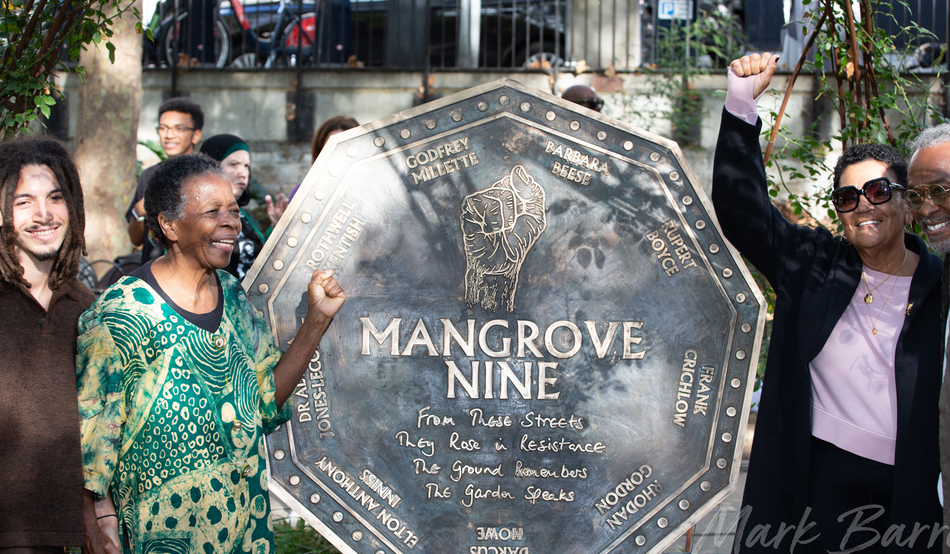
Altheia Jones-LeCointe is pragmatic about the past—and about foxes.
The former de facto leader of the British Black Panthers is admiring a russet fox in the garden of her London home.
“You’re beautiful,” says Jones-LeCointe, “but keep to your side.” In 1971, Jones-LeCointe became one of the Mangrove Nine, a group of protesters whose landmark trial marked the first judicial acknowledgement of racial prejudice within London’s Metropolitan Police.
The case arose from a demonstration against repeated police raids of the Mangrove restaurant in Notting Hill, run by the Trinidadian-born civil rights campaigner Frank Crichlow.
No evidence of illegal activity was ever found and community members, who saw the Mangrove as something of a local sanctuary, marched for an end to police harassment.
After clashes broke out during the protest, Jones-LeCointe and eight others were arrested and charged with offences including incitement to riot.
Born in 1945, she grew up in Trinidad as the movement for independence gathered momentum, while her parents were involved in the People’s National Movement, a liberal party founded by politician Eric Williams.
Her childhood was busy with political meetings at her home, delivering leaflets, and gathering in the square to hear Williams speak.
“We would say ‘masa day done’, which meant the master’s day was over.” Enrolled at Trinidad’s prestigious Bishop Anstey High School for girls, Jones-LeCointe recalls placing a poster proclaiming “masa day done” on her desk.
I suggest that the possibility of change must have felt potent from an early age.
“You’ve hit the nail on the head,” smiles Jones-LeCointe.
Aged 14, Jones-LeCointe discovered only Latin, French and Spanish were available for further study, effectively reserving science for boys.
She transferred to a mixed school to study physics and chemistry.
Her white headmistress was furious.
Another education followed her arrival into Britain in 1965 for a PhD in biochemistry at University College London.
As a black woman walking into an all-white class, Jones-LeCointe was asked by a fellow student: “Are you sure you’re in the right place?” “I thought to myself, ‘who the fuck do you think you are, boy?’” Jones-LeCointe’s armoured internal response....