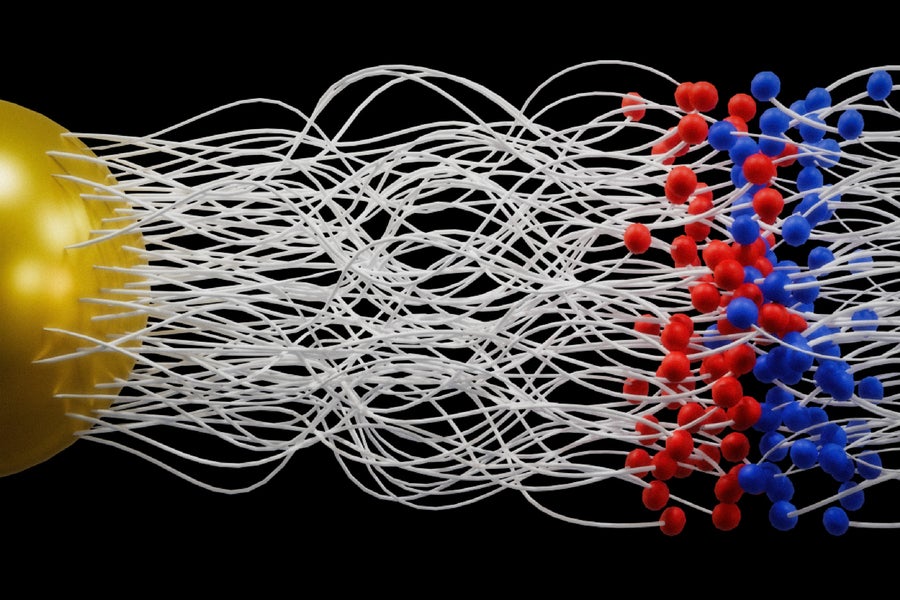
Making molecular connectors bendier might sound like a recipe for a disorganized material.
Instead, extremely flexible connectors helped tiny particles form ordered networks with fewer neighbors.
The finding challenges a common assumption in nanoparticle assembly: that controlling structure requires connectors locked into particular directions.
Here, the connectors helped establish those directions as assembly unfolded.
A team including researchers at the Massachusetts Institute of Technology demonstrated the approach using nanoparticles coated with flexible polymer chains.
Electrically charged tips drew the chains together, while their ability to deform influenced the resulting arrangements.
The study, published in Nature Materials, combines experiments with simulations to explain this unexpected route to structural control.
The work addresses a stubborn problem in making nanoparticle-based materials.
Individual particles can have useful properties, but assembling them into larger structures adds another design challenge.
Their arrangement matters alongside their composition.
Controlling that arrangement could expand the kinds of materials scientists can build from the same starting particles.
A material's structure helps determine what it does.
Nanoparticles offer building blocks whose sizes, shapes and compositions can be adjusted for different purposes.
They already feature in research and applications involving drug delivery, energy storage, computing and sensing.
Turning those building blocks into an organized network, however, requires control over their interactions.
“That means if you know what your building blocks are and how they’re arranged, you can explain what properties materials have,” said Rob Macfarlane.
He is the Richard P.
Simmons Professor in Metallurgy in MIT's Department of Materials Science and Engineering.
“Controlling that is how you make materials that have new properties.” One obstacle is the tendency of attracting particles to pack densely.
Such arrangements provide many neighboring contacts, but they restrict the available architectures.
Scientists call repeating, ordered nanoparticle arrangements superlattices.
Making a more open superlattice requires some way to limit how many neighbors each particle connects with.
Earlier strategies have included changing particle shapes or making selected surface regions sticky.
Those features can guide particles into particular arrangements.
But producing them can require elaborate synthesis tailored to a specific material, size or condition.
A successful laboratory recipe therefore does not automatically become a broadly usable manufacturing method.
The team focused on ligands, molecules attached to nanoparticle surfaces that influence how particles interact.
In many directional assembly strategies, these connectors must preserve particular orientations.
The researchers instead explored the opposite extreme.
They wanted connectors flexible enough to reorganize as neighboring particles approached one another.
“We thought, ‘Let’s do the exact opposite: make the bonds so flexible it doesn’t matter what direction they’re initially pointing.’ The ligands can then reorganize as the particles come together, and that reorganization itself limits how many neighbors each particle can bind,” Macfarlane said.
That shifts part of the design problem from fixed geometry to molecular behavior.
The connections emerge through assembly itself.
The system uses flexible polymer ligands with electrically charged tips.
Some tips carry positive charges, while others carry negative charges.
Opposite charges attract, encouraging the chains to bend toward compatible partners.
Their flexibility allows the connecting molecules to respond to the surrounding particles rather than retain a predetermined direction.
This is a form of self-assembly, in which interactions among components produce an organized structure.
The particles are not individually placed into position.
Instead, their surface chemistry shapes how they come together.
The important question is which arrangements those interactions favor when the connectors can deform substantially.
As the particles assemble, their flexible outer coatings can reorganize along the interfaces between them.....